
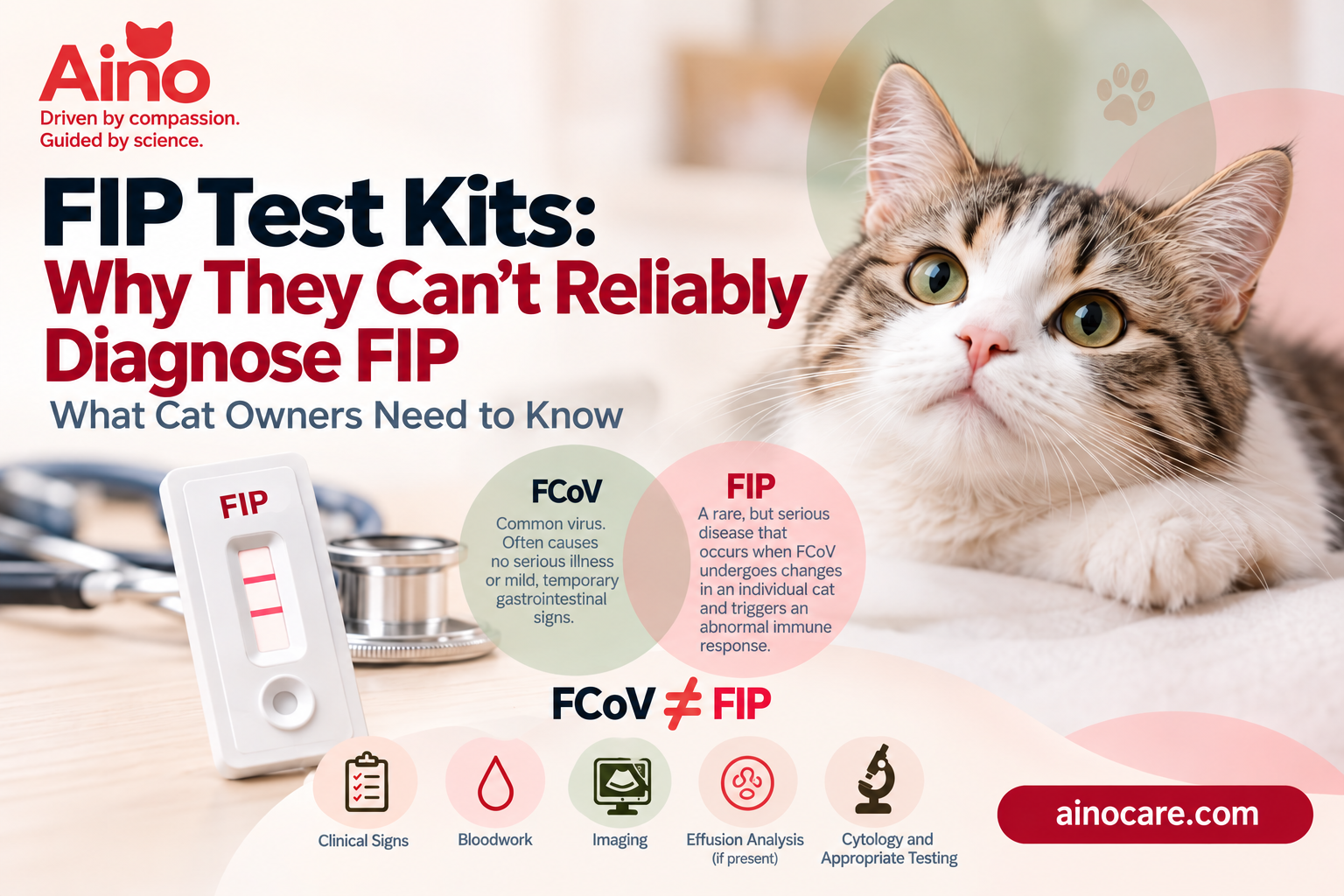
Is There a Reliable FIP Test for Cats?
Is there a reliable FIP test for cats?
What does a positive FIP test actually mean?
And can a negative result rule out feline infectious peritonitis?
These are common questions from cat owners facing a suspected case of feline infectious peritonitis (FIP).
The short answer is: there is no simple, standalone test that can reliably diagnose FIP in every cat.
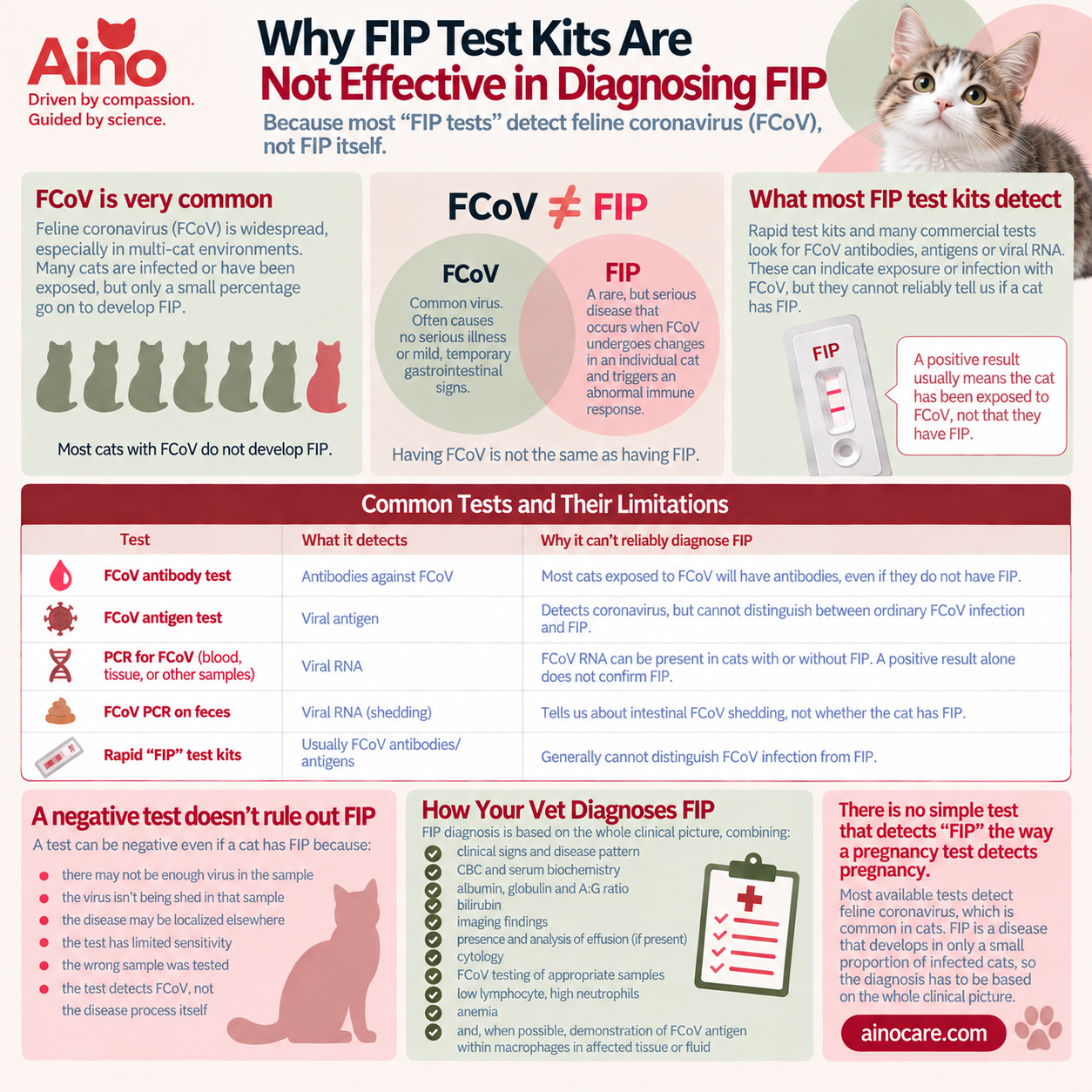
Many products marketed as “FIP tests” detect feline coronavirus (FCoV), or the cat’s immune response to FCoV.
But FCoV infection and FIP are not the same thing. That distinction is critical.
A cat can test positive for FCoV without having FIP. And, depending on the test and sample used, a negative result does not necessarily rule FIP out.
Instead, veterinarians diagnose FIP by putting multiple pieces of evidence together: the cat’s clinical signs, bloodwork, imaging, effusion characteristics when present, and appropriately selected tests for FCoV.
FCoV Is Not the Same as FIP
Feline coronavirus is extremely common among cats. Most FCoV infections cause no significant illness or may cause only mild gastrointestinal disease. Only a proportion of FCoV-infected cats develop FIP.
This is why a test that simply detects evidence of FCoV cannot automatically answer the question:
“Does this cat have FIP?”
A positive FCoV antibody test, for example, generally tells us that the cat has been exposed to FCoV and developed antibodies. It does not specifically identify FIP. The current ABCD guideline notes that FCoV antibody titres overlap considerably between cats with and without FIP, making serum antibody testing of limited value for diagnosing FIP in an individual cat.
In other words:
FCoV positive ≠ FIP positive.
Why Are FIP Test Kits So Difficult to Interpret?
The problem is partly one of terminology.
A product may be marketed as an “FIP test,” but the test may actually detect one of several things associated with feline coronavirus:
- FCoV antibodies
- FCoV antigen
- FCoV RNA
- FCoV shedding
- or other indirect markers associated with coronavirus infection
These findings can be useful to a veterinarian, but their diagnostic value depends heavily on what was tested, where the sample came from, and what other abnormalities the cat has.
There is no universally reliable “yes/no” test that works like a pregnancy test.
Cornell University’s feline health guidance similarly notes that there is currently no definitive test for FIP and that PCR, immunofluorescence, immunoperoxidase testing and other investigations each have limitations that can produce false-positive or false-negative results.
What About FCoV Antibody Tests?
FCoV antibody tests are among the tests commonly confused with an actual FIP diagnostic test.
A positive antibody result means the cat has developed antibodies against feline coronavirus.
But FCoV exposure is common.
Cats with FIP may have high antibody levels, but cats without FIP can also have high antibody levels. There is substantial overlap between the two groups. The ABCD guideline therefore states that serum FCoV antibody testing has little diagnostic value for FIP in an individual cat.
So if your cat has a positive coronavirus antibody test, the result should not be interpreted as:
“Your cat has FIP.”
It means something much narrower:
“Your cat has evidence of exposure to feline coronavirus.”
That is useful information, but it is not the same diagnosis.
What About FCoV PCR?
PCR is more complicated.
PCR detects viral genetic material, and the value of the result depends greatly on the sample.
For example, detecting FCoV RNA in feces primarily tells us about intestinal viral shedding. It does not establish that a cat has developed FIP.
Blood PCR can also be informative, but a positive result alone is not specific enough to establish FIP. The current ABCD guideline reports that FCoV RNA can occasionally be detected in cats without FIP, while blood PCR can also have limited sensitivity in cats that do have FIP.
This is why “PCR positive” does not automatically equal “FIP positive.”
Sample selection matters.
When FIP is suspected and an effusion is present, testing the effusion can provide substantially more useful diagnostic information than simply testing blood. The current ABCD guideline specifically recommends prioritizing effusion sampling when available.
Why the Sample Matters
Imagine two cats:
Cat A has FCoV RNA detected in feces but is otherwise healthy.
Cat B has abdominal effusion with high protein, compatible cytology, systemic illness, characteristic bloodwork, and high FCoV RNA detected in the effusion.
Both may technically have a “positive coronavirus PCR.”
But the diagnostic meaning is completely different.
This is why FIP diagnosis cannot be separated from the clinical context and sample type.
Cornell’s diagnostic guidance likewise emphasizes that FIP is generally approached using a combination of history, physical examination and laboratory findings rather than relying on one test.
Can a Negative FIP Test Rule Out FIP?
Not necessarily.
A negative result may occur because:
- there is too little viral material in the sample
- the virus is not present in that particular sample
- viral antigen is unevenly distributed within affected tissue
- the wrong sample was tested
- the test has limited sensitivity
- the disease is localized somewhere else
- or the particular assay simply failed to detect what was present
Even direct detection methods have limitations.
For example, the current ABCD guideline states that negative FCoV antigen immunostaining does not exclude FIP because FCoV antigen can be sparsely or unevenly distributed within affected tissues.
Therefore:
A negative test does not automatically mean “no FIP.”
It means the veterinarian needs to interpret that result alongside everything else known about the patient.
Why There Isn't One "FIP Test"
FIP is complicated because the disease can present in many different ways.
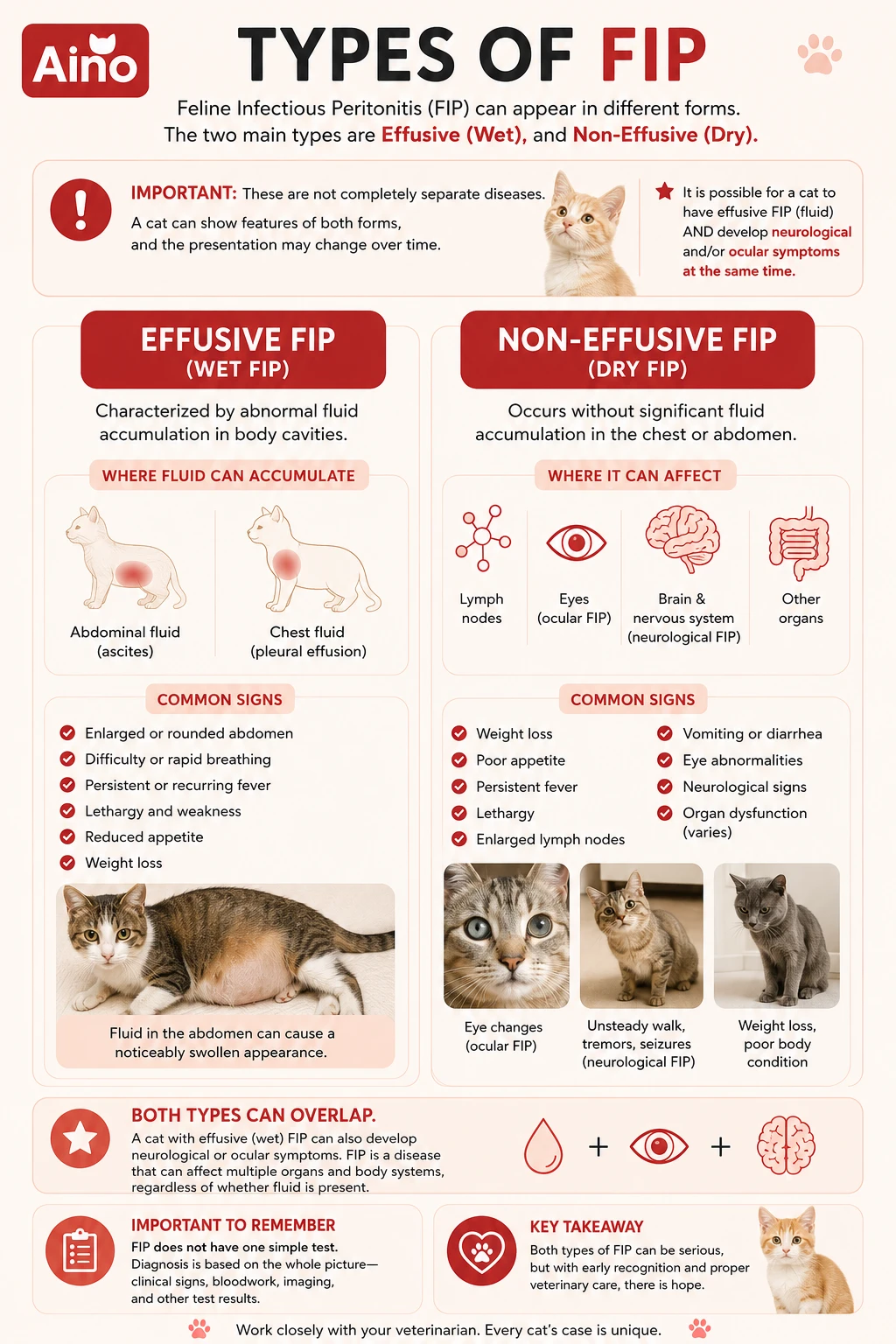
A cat with effusive FIP may have a very different presentation from a cat with neurological or ocular FIP.
The disease can involve different organs, and the amount and distribution of detectable virus can vary between tissues and body fluids.
That means the most useful sample for one cat may not be the most useful sample for another.
This is precisely why the 2022 AAFP/EveryCat FIP Diagnosis Guidelines were developed to help veterinarians build a diagnostic work-up rather than rely on a single test. The guidelines emphasize evaluating the characteristics and pathogenesis of FIP alongside the limitations of individual diagnostic tests.
What Should Cat Owners Take Away From an FIP Test Result?
If your cat receives a positive result from something marketed as an “FIP test,” don’t panic.
Ask your veterinarian:
What exactly did this test detect?
Was it:
- FCoV antibodies?
- FCoV antigen?
- FCoV RNA?
- A test performed on blood?
- Feces?
- Effusion?
- Tissue?
- Another sample?
Then ask the more important question:
“How does this result fit with my cat’s other findings?”
That is the question that moves the conversation from a test result to a diagnosis.
Likewise, if a test comes back negative but your veterinarian still suspects FIP, that does not necessarily mean the veterinarian is ignoring the test.
They may be considering the test’s sensitivity, the sample that was tested, the stage and form of disease, and the rest of the clinical evidence.
The Bottom Line: FIP Is a Clinical Diagnosis, Not a Strip Test
The biggest misconception about FIP testing is the idea that there is one simple test that can answer the question: “Does this cat have FIP?”
In reality, FIP diagnosis often requires a combination of evidence.
A positive FCoV antibody test does not prove FIP.
A positive FCoV PCR does not automatically prove FIP.
A negative test does not necessarily rule FIP out.
And a veterinarian should not diagnose or exclude FIP based on one isolated result when the rest of the clinical picture tells a different story.
The most valuable approach is to combine the cat’s history, clinical signs, bloodwork, imaging, fluid or tissue findings, and appropriately selected FCoV testing.
That is why your veterinarian’s interpretation matters.
FIP is more than a test result. It is a diagnosis built from the whole clinical picture.
Frequently Asked Questions
1. Is there a test that definitively diagnoses FIP?
There is no simple, universally applicable standalone test for FIP. Definitive diagnosis can be achieved in appropriate tissue samples when characteristic histopathological changes are accompanied by FCoV antigen detected by immunostaining. In many living patients, however, veterinarians work toward a highly probable diagnosis using multiple findings.
2. Does a positive FCoV test mean my cat has FIP?
No. FCoV is common among cats, and a positive antibody test generally indicates exposure to feline coronavirus rather than FIP. FCoV PCR results also require interpretation based on the sample and clinical context.
3. Can a negative FIP test rule out FIP?
Not necessarily. Test sensitivity varies, and FCoV may not be detectable in every sample or may be unevenly distributed in affected tissues.
4. Is FCoV PCR useful for diagnosing FIP?
Yes, PCR can be useful, but its diagnostic value depends strongly on the sample. When effusion is present, testing the effusion can be particularly informative. A positive PCR result should still be interpreted alongside cytology, biochemistry and the clinical picture.
5. What blood test indicates FIP?
There is no single blood test that confirms FIP. CBC and serum biochemistry can provide important supporting evidence, including abnormalities such as lymphopenia, neutrophilia, anemia, hyperglobulinemia and a reduced A ratio, but these findings are not specific to FIP.
7. What is the best sample for FIP testing?
There is no single best sample for every cat. When an effusion is present, sampling the effusion for cytology, biochemistry and appropriate FCoV testing is particularly valuable. If there is no effusion, fine-needle aspiration of accessible abnormal tissue may provide useful diagnostic material.
8. Why do some companies call their antibody test an “FIP antibody test”?
A serum FCoV antibody test detects antibodies against feline coronavirus. The ABCD guideline specifically notes that there is no distinct “FIP antibody test”: antibodies can be produced against different forms of FCoV, and antibody testing cannot reliably distinguish ordinary FCoV exposure from FIP.
If your cat is suspected of having FIP
Ask your veterinarian questions. Understanding what each test is looking for, what its results can and cannot tell you, and what other conditions are being considered can make an overwhelming situation easier to navigate.
Most importantly, don’t feel that you need to understand every laboratory abbreviation or diagnostic test overnight.
Your veterinarian’s job is to interpret the findings in the context of your individual cat.
FIP can be a complicated diagnosis. But with a careful, systematic approach, the pieces can begin to come together.
Driven by compassion, guided by science | ainocare.com
This article is intended for educational purposes and should not replace veterinary examination or individualized diagnostic advice. FIP can resemble other diseases, and diagnostic testing should be selected and interpreted by a veterinarian based on the individual cat.