
How is FIP Diagnosed in Cats?
If you’ve ever heard the words “We suspect FIP”, you may have immediately wondered: But how do they know? Is there a test that confirms it?
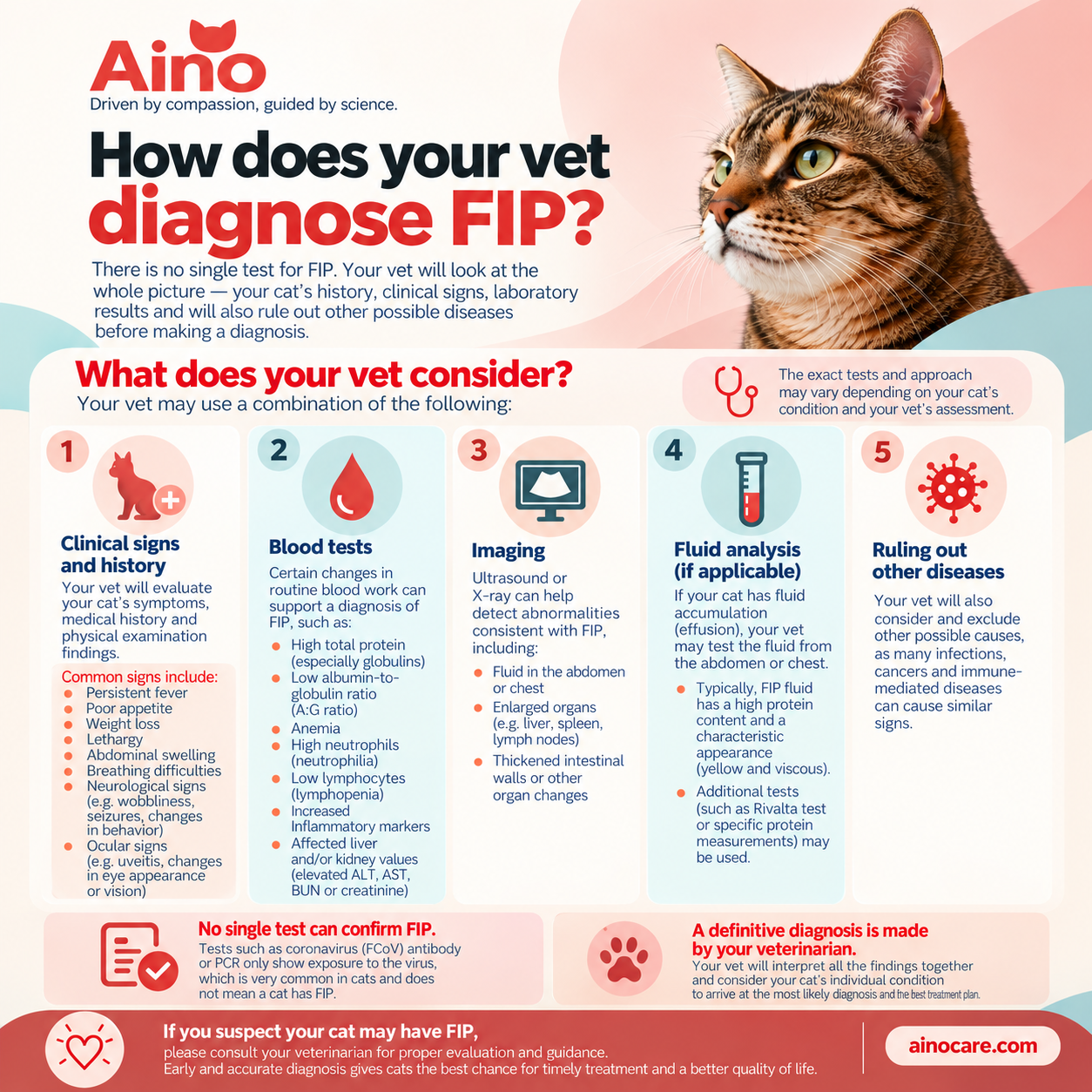
The short answer is: FIP is not usually diagnosed with one single test.
Feline infectious peritonitis can affect different organs and can look very different from one cat to another. Because of this, veterinarians generally build the diagnosis by putting together several pieces of information, including your cat’s history, clinical signs, physical examination, laboratory results, imaging findings, and, when appropriate, analysis of body fluids. The 2022 AAFP/EveryCat FIP Diagnosis Guidelines describe this as building the clinical suspicion “brick by brick.”
Read on to see how FIP is diagnosed in cats.
FIP Diagnosis in Simple Terms
For furparents, it may help to think of the process as a series of questions:
1. What is happening to my cat?
Your veterinarian looks at your cat’s symptoms, history, physical examination, and overall condition.
2. Do the blood tests support the suspicion?
Bloodwork may show patterns such as high globulins, a low A:G ratio, anemia, neutrophilia, lymphopenia, inflammatory changes, or liver and/or kidney abnormalities.
3. Are there changes inside the body that support the picture?
X-rays or ultrasound may identify fluid, enlarged lymph nodes, or changes affecting organs.
4. Is there fluid that can be tested?
If your cat has fluid in the chest or abdomen, testing that fluid can provide additional clues and may allow more specific testing.
5. Could something else be causing the same signs?
Your veterinarian may perform additional tests to rule out other infections, inflammatory conditions, cancers, or other diseases that can look similar to FIP.
The Key Takeaway
FIP is diagnosed by putting these pieces together, not by relying on one positive or negative test.
Some findings can make FIP more likely, while others may point toward a different condition. Your veterinarian interprets the results together and decides whether the overall picture is consistent with FIP and whether further testing is needed.
And because FIP can look different from one cat to another, not every cat will need the same tests.
So, what might your veterinarian look at?
1. Clinical signs and medical history
The diagnostic process usually begins with your cat.
Your veterinarian will consider your cat’s age, medical history, how the illness developed, physical examination findings, and the combination of signs your cat is showing.
Possible signs associated with FIP include:
- Persistent or recurring fever
- Poor appetite
- Weight loss
- Lethargy
- Abdominal swelling
- Difficulty breathing
- Neurological signs such as wobbliness, seizures, or changes in behaviour
- Ocular signs such as uveitis or changes in the appearance or function of the eyes
FIP can affect many different organs, so not every cat will show the same combination of signs. Neurological and ocular FIP, for example, may present quite differently from cats with abdominal or chest effusion.
This is one reason the history matters so much. A single symptom rarely tells the whole story.
2. Blood tests
Routine bloodwork cannot diagnose FIP by itself, but it can provide important clues and help your veterinarian assess your cat’s overall condition.
Depending on the individual cat, findings may include:
Changes in proteins
Cats with FIP may have increased globulins, decreased albumin, or a lower albumin-to-globulin (A:G) ratio.
A low A:G ratio can increase suspicion for FIP, but it is not specific to FIP and must be interpreted alongside other findings.
Changes in red and white blood cells
Some cats with FIP develop anemia or changes in their white blood cell counts.
Two findings that may be seen are:
- Neutrophilia: an increased number of neutrophils, a type of white blood cell involved in the body’s inflammatory response.
- Lymphopenia: a decreased number of lymphocytes, another type of white blood cell involved in immune function.
The combination of neutrophilia and lymphopenia can occur in cats with FIP and may contribute to the overall clinical suspicion, particularly when other findings are also consistent with FIP.
However, these changes are not specific to FIP. Stress, inflammation, infection, and other diseases can also cause changes in white blood cell counts. They therefore need to be interpreted in the context of the cat’s complete clinical picture.
Liver and kidney changes
Blood chemistry may also show abnormalities involving the liver and/or kidneys, depending on which organs are affected.
These may include elevated liver enzymes such as ALT or AST, or changes in kidney-related values such as BUN or creatinine.
These abnormalities do not automatically mean that a cat has FIP. Rather, they give the veterinarian additional information about what may be happening inside the body and whether particular organs are involved.
In other words, bloodwork helps build the picture. It does not provide the entire picture.
3. Imaging
Your veterinarian may recommend an X-ray or ultrasound depending on your cat’s symptoms and examination findings.
Imaging can help identify things such as:
- Fluid in the abdomen or chest
- Enlarged abdominal lymph nodes
- Changes involving the liver, spleen, kidneys, or intestines
- Other structural abnormalities
Ultrasound can also help locate fluid and guide the collection of samples when fluid or tissue needs to be examined.
For cats with neurological signs, more advanced imaging such as MRI may sometimes be considered.
Importantly, imaging findings are not necessarily unique to FIP. They are another piece of the diagnostic puzzle.
4. Fluid analysis, when applicable
One of the most useful opportunities for additional testing occurs when a cat has an abnormal accumulation of fluid, known as an effusion.
This may occur in the abdomen or chest.
If fluid is available, your veterinarian may examine its appearance and measure its protein and cellular characteristics. FIP-associated effusions commonly have relatively high protein concentrations and characteristic laboratory features, although similar findings can occur with other diseases.
Additional tests may also be performed on the fluid, depending on the circumstances. These can include tests such as a Rivalta test, protein measurements, cytology, or testing for feline coronavirus genetic material.
Again, no single result should automatically be interpreted as “this is FIP.”
5. Cytology, ICC, IHC and histopathology
Sometimes, veterinarians need to look more closely at cells or tissue to investigate whether the changes are consistent with FIP.
Cytology examines individual cells collected from a fluid sample or fine-needle aspirate. It can provide useful information about inflammation and other cellular changes.
Immunocytochemistry (ICC) can be used on certain cell samples to look for feline coronavirus (FCoV) antigen. A positive result, when the other findings are consistent with FIP, can provide strong supporting evidence, although interpretation depends on the sample and clinical context.
Histopathology examines a tissue sample under a microscope to look for characteristic lesions associated with FIP. When tissue shows compatible histopathological changes and FCoV antigen is demonstrated by immunohistochemistry (IHC), this is considered the gold-standard approach for confirming FIP.
These tests can provide much stronger evidence than routine bloodwork alone. However, obtaining tissue may require an invasive procedure, and biopsy is not always practical or appropriate, particularly in a sick or unstable cat.
In other words, these tests can be extremely valuable when available, but not every cat suspected of having FIP will need or be able to undergo them.
6. Ruling out other diseases
This part of the process is easy to overlook, but it is extremely important.
Many conditions can cause signs that overlap with FIP, including other infections, inflammatory diseases, and cancers.
That means your veterinarian may recommend additional tests not specifically to “prove FIP,” but to determine whether another disease could better explain what is happening.
FIP diagnosis relies on combining clinical information and diagnostic testing rather than relying on one isolated finding.
What about FCoV antibody tests and PCR?
This is one of the most confusing parts for many furparents.
A positive feline coronavirus (FCoV) antibody test generally tells us that a cat has been exposed to feline coronavirus. It does not by itself mean that the cat has FIP.
PCR can detect feline coronavirus genetic material, but the interpretation depends heavily on what sample was tested, where it came from, and the clinical context.
Because feline coronavirus exposure is common, these tests need to be interpreted carefully alongside the rest of the diagnostic findings.
So, is there a definitive FIP test?
For many cats, especially while they are alive, veterinarians are working toward a presumptive diagnosis based on the overall evidence rather than receiving one definitive “FIP positive” result.
In some cases, obtaining an absolutely definitive diagnosis can be difficult because of the location of the disease, the condition of the patient, the availability of testing, or the risks and costs of invasive procedures.
This is why FIP diagnosis can sometimes feel frustratingly complicated.
It isn’t necessarily because something has been missed. The disease itself can be complicated to diagnose.
The big picture matters
Think of FIP diagnosis as putting together a puzzle.
- Clinical signs and history
- Physical examination findings
- Bloodwork, including protein and white blood cell changes
Imaging - Fluid analysis, when available
- Additional targeted tests
- Evidence that helps rule out other diseases
No single piece has to tell the whole story.
Instead, your veterinarian considers how the pieces fit together and determines whether the overall pattern is consistent with FIP and what additional information may be needed.
And because every cat is different, the diagnostic approach may look different from one patient to another.
If your cat is suspected of having FIP
Ask your veterinarian questions. Understanding what each test is looking for, what its results can and cannot tell you, and what other conditions are being considered can make an overwhelming situation easier to navigate.
Most importantly, don’t feel that you need to understand every laboratory abbreviation or diagnostic test overnight.
Your veterinarian’s job is to interpret the findings in the context of your individual cat.
FIP can be a complicated diagnosis. But with a careful, systematic approach, the pieces can begin to come together.
Driven by compassion, guided by science | ainocare.com
This article is intended for educational purposes and is not a substitute for veterinary diagnosis or medical advice. Diagnostic testing should be selected and interpreted by a veterinarian based on the individual cat.