Your cat has just been diagnosed with FIP. What now?
Hearing the words “feline infectious peritonitis” (FIP) can be frightening. FIP has historically been considered one of the most devastating diagnoses in veterinary medicine, and it can be especially overwhelming when you are faced with unfamiliar tests, medical terms, and treatment decisions.
But there is important news for cat owners: FIP is no longer considered an automatically fatal disease. Effective antiviral treatments have changed the outlook for many cats, with current veterinary guidelines reporting recovery rates of over 85% in appropriately treated cases.
The first step is understanding what FIP is, what your veterinarian is looking for, and what information you can gather to help guide the next steps.
What Is FIP?
Feline infectious peritonitis (FIP) is a serious disease caused by feline coronavirus (FCoV).
Feline coronavirus is common among cats, particularly in environments where many cats live together. Most cats infected with FCoV do not develop FIP. In a small proportion of cats, however, the infection is associated with the development of FIP. The disease results from a complex interaction between the virus and the cat’s immune response and can affect multiple organs throughout the body.
FIP can occur in cats of any age, although it is particularly common in younger cats, especially those under two years of age.
Why is FIP so difficult to diagnose?
FIP does not have one simple, definitive blood test that can be used in every cat.
Many of its signs, such as fever, poor appetite, weight loss, lethargy, and changes in bloodwork, can also occur with other diseases. Likewise, detecting feline coronavirus does not automatically mean that a cat has FIP, because many healthy cats have been exposed to FCoV.
For this reason, veterinarians generally assess the whole picture: your cat’s history, clinical signs, physical examination, bloodwork, imaging, fluid analysis, and, when appropriate, tests performed on affected tissues or body fluids.
Think of FIP diagnosis less as finding one missing puzzle piece and more as seeing whether the pieces form a consistent picture.
FIP Types
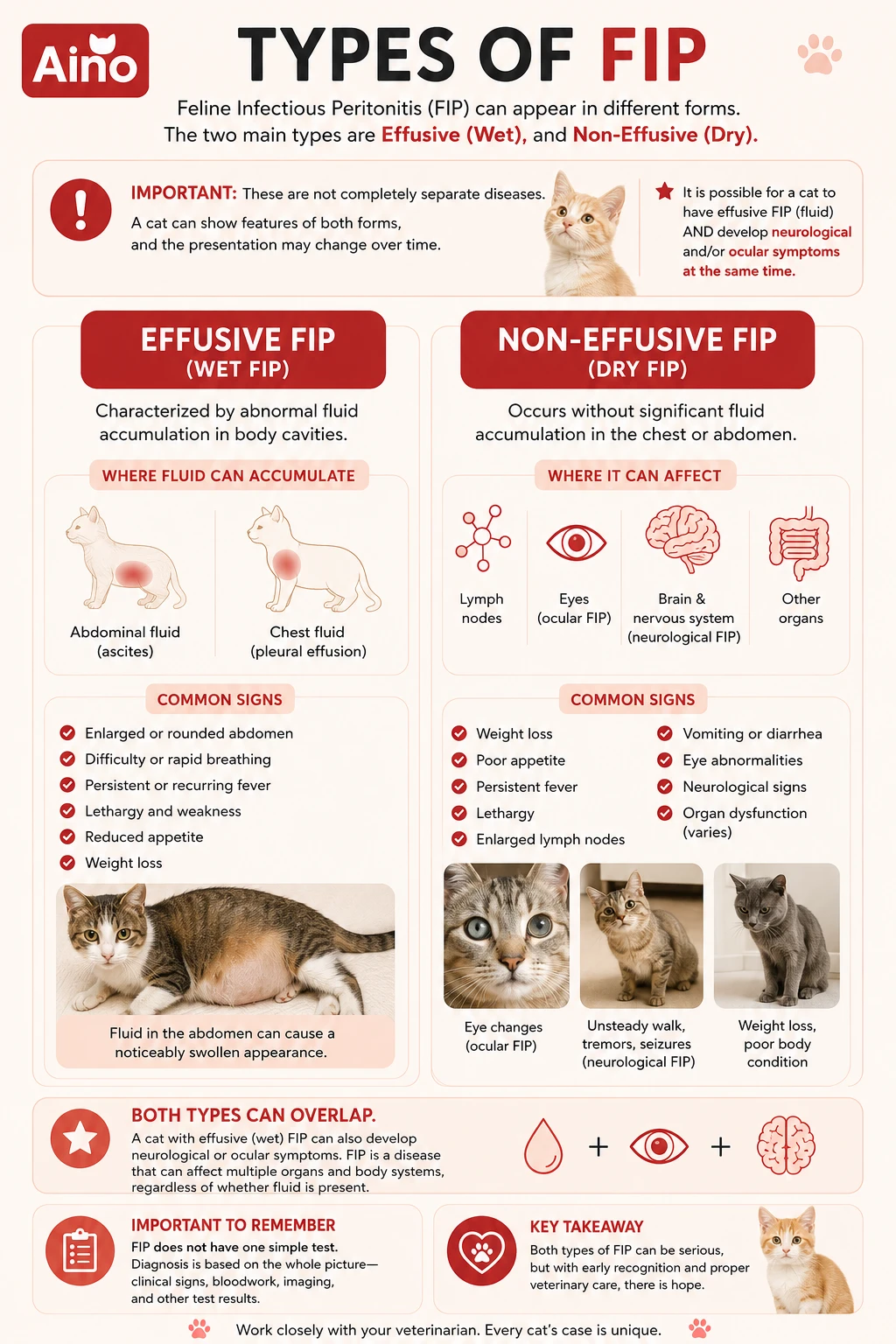
FIP is commonly described as effusive (wet) or non-effusive (dry). These are useful descriptions, but they are not completely separate diseases. A cat can show features of both forms, and the presentation can change over time.
Effusive FIP
Effusive FIP involves the accumulation of fluid in the body’s cavities.
Depending on where the fluid accumulates, a cat may develop:
- Abdominal fluid (ascites), which can make the abdomen appear enlarged or rounded
- Chest fluid (pleural effusion), which can cause rapid or difficult breathing
- Lethargy and weakness
- Reduced appetite
- Weight loss
- Persistent or recurring fever
When fluid is present, collecting and analyzing that fluid can provide valuable diagnostic information. Current FIP guidelines consider sampling an effusion one of the most useful diagnostic steps when fluid is available.
Non-Effusive FIP
Non-effusive FIP occurs without significant fluid accumulation in the abdomen or chest.
Signs can vary considerably depending on which organs are affected. A cat may experience:
- Weight loss
- Poor appetite
- Persistent fever
- Lethargy
- Enlarged lymph nodes
- Gastrointestinal signs
- Eye abnormalities
- Neurological signs
Some cats develop ocular FIP, affecting the eyes, or neurological FIP, affecting the brain, spinal cord, or nervous system.
These presentations can be particularly challenging to recognize because their signs may resemble those of many other diseases.
Signs & Symptoms
FIP can look very different from one cat to another.
Some cats become seriously ill over a relatively short period, while others develop more gradual or unusual signs.
Common signs
Watch for:
- Persistent or recurring fever
- Reduced appetite or complete loss of appetite
- Weight loss
- Lethargy or unusual tiredness
- Poor body condition
- Enlarged abdomen
- Difficulty breathing
- Vomiting or diarrhea
- Pale or yellowish gums
- Enlarged lymph nodes
Possible neurological signs
Neurological FIP may cause:
- Unsteady walking or loss of coordination
- Difficulty jumping or walking normally
- Difficulty swallowing
- Tremors
- Abnormal movements
- Seizures
- Changes in behavior or awareness
- Paralysis
- Urinary/fecal incontinence
- Anisocoria
- Nystagmus
- Blindness
Possible eye-related signs
Ocular FIP may cause:
- Changes in eye color or appearance
- Cloudiness
- Inflammation inside the eye
- Changes in the pupil
- Vision problems
Not every cat with these signs has FIP. Many other conditions can produce similar symptoms, which is why veterinary assessment is essential.
Diagnosis Guide
There is no single “FIP test”
One of the most important things for an owner to understand is that a positive coronavirus test does not, by itself, diagnose FIP.
Similarly, a negative result from a single test does not necessarily rule FIP out.
Veterinarians usually combine several types of information to determine how likely FIP is.
1. History and clinical examination
Your veterinarian may consider:
- Your cat’s age
- Recent illness or changes in health
- Weight loss and appetite
- Fever
- Abdominal or chest changes
- Neurological or eye abnormalities
- Previous medical history
- Other possible causes of the signs
2. Bloodwork
A complete blood count and biochemistry profile can reveal abnormalities that support suspicion of FIP.
Depending on the cat, your veterinarian may look at parameters such as:
- Total protein
- Albumin
- Globulin
- Albumin-to-globulin ratio (A ratio)
- Bilirubin
- Liver enzymes
- Kidney values
- Complete blood count
- Other inflammatory or disease markers
These findings can help build the clinical picture, but bloodwork alone cannot confirm FIP.
3. Ultrasound or other imaging
Imaging may help identify:
- Abdominal or chest fluid
- Enlarged lymph nodes
- Changes in abdominal organs
- Masses or inflammatory lesions
- Other abnormalities that may need further investigation
If fluid is found, your veterinarian may recommend collecting a sample for further testing.
4. Fluid analysis
When an effusion is present, testing the fluid can be particularly valuable.
The veterinarian may assess:
- Appearance
- Protein concentration
- Cell types
- Cytology
- Feline coronavirus RNA by RT-PCR
- Feline coronavirus antigen by immunostaining
A fluid sample showing characteristics strongly consistent with FIP together with evidence of FCoV can make FIP very likely.
5. PCR
PCR can detect feline coronavirus genetic material.
However, a positive PCR result does not automatically mean FIP. FCoV can be detected in cats that do not have FIP, and a negative result does not always exclude the disease.
The meaning of a PCR result depends heavily on what sample was tested and the rest of the clinical picture.
Cytology, ICC, IHC and histopathology
When appropriate, veterinarians may examine cells or tissue for changes associated with FIP and look for feline coronavirus antigen.
Histopathology combined with positive FCoV antigen immunostaining is considered confirmatory for FIP. However, obtaining tissue samples may be invasive and is not always practical or appropriate for a sick cat.
The bottom line
FIP diagnosis is about the evidence as a whole.
A veterinarian may reach a diagnosis that FIP is very likely without obtaining a traditional definitive diagnosis, particularly when the clinical picture, laboratory findings, imaging, and appropriate sample testing all point in the same direction.
Owner Checklist
If your cat has suspected or confirmed FIP, having the right information organized can make conversations with your veterinarian much easier.
Gather your cat’s information
- Age and current weight
- Date symptoms first appeared
- Recent weight changes
- Appetite and water intake
- Temperature history, if available
- Current medications and supplements
- Previous illnesses or medical conditions
- Recent vaccination, surgery, relocation, boarding, or other major stressors
- Photos or videos showing unusual symptoms
- A record of bowel movements, vomiting, appetite, and activity
Ask your veterinarian
- What findings make you suspect FIP?
- What other diseases are being considered?
- Does my cat have effusive or non-effusive disease?
- Is there abdominal or chest fluid?
- Would ultrasound be useful?
- Should the fluid be sampled and tested?
- What do my cat’s bloodwork results mean?
- Are additional tests needed?
- Which organs or body systems appear to be affected?
- What should we monitor during treatment?
- What changes should prompt an urgent veterinary visit?
Keep a treatment and monitoring record
Once treatment begins, keep a simple daily record of:
- Body weight
- Appetite
- Energy and activity
- Temperature, if your veterinarian recommends monitoring it
- Medication given and time administered
- Vomiting or diarrhea
- Breathing changes
- Neurological or eye changes
- Any new or worsening symptoms
Small changes can be clinically important. A daily record gives you and your veterinarian something much more useful than trying to remember what happened over the previous week.
One Important Thing to Remember
FIP is serious. But serious does not mean hopeless.
The diagnosis can be complicated, and the first few days can feel like a blur of tests, uncertainty, and difficult decisions. Start with the information you have, work closely with your veterinarian, and take the process one step at a time.
There is now effective antiviral therapy for FIP, and veterinary guidelines recognize that many appropriately treated cats can recover.
You do not have to understand everything on day one. The goal of this guide is to help you understand what FIP is, what your veterinarian is looking for, and what questions to ask next.
Clinics Experienced in FIP Treatment
A cat with FIP may benefit from veterinary care from a clinic that is familiar with the disease, its different presentations, and the monitoring required during treatment.
Experience with FIP can be especially valuable when a cat has a complicated presentation, such as neurological or ocular involvement, significant fluid accumulation, kidney or liver abnormalities, or other concurrent conditions.
Looking for a Clinic?
We are building a directory of veterinary clinics and veterinarians with experience in caring for cats with FIP. Click here.
The purpose of this directory is to help caregivers find veterinary professionals who are familiar with the challenges of FIP diagnosis, treatment, and monitoring.
When contacting a clinic, it can help to have your cat’s recent bloodwork, imaging reports, diagnostic test results, current weight, medication history, and a timeline of symptoms ready to share.
Early, informed veterinary care can make a significant difference in managing a complex FIP case.