
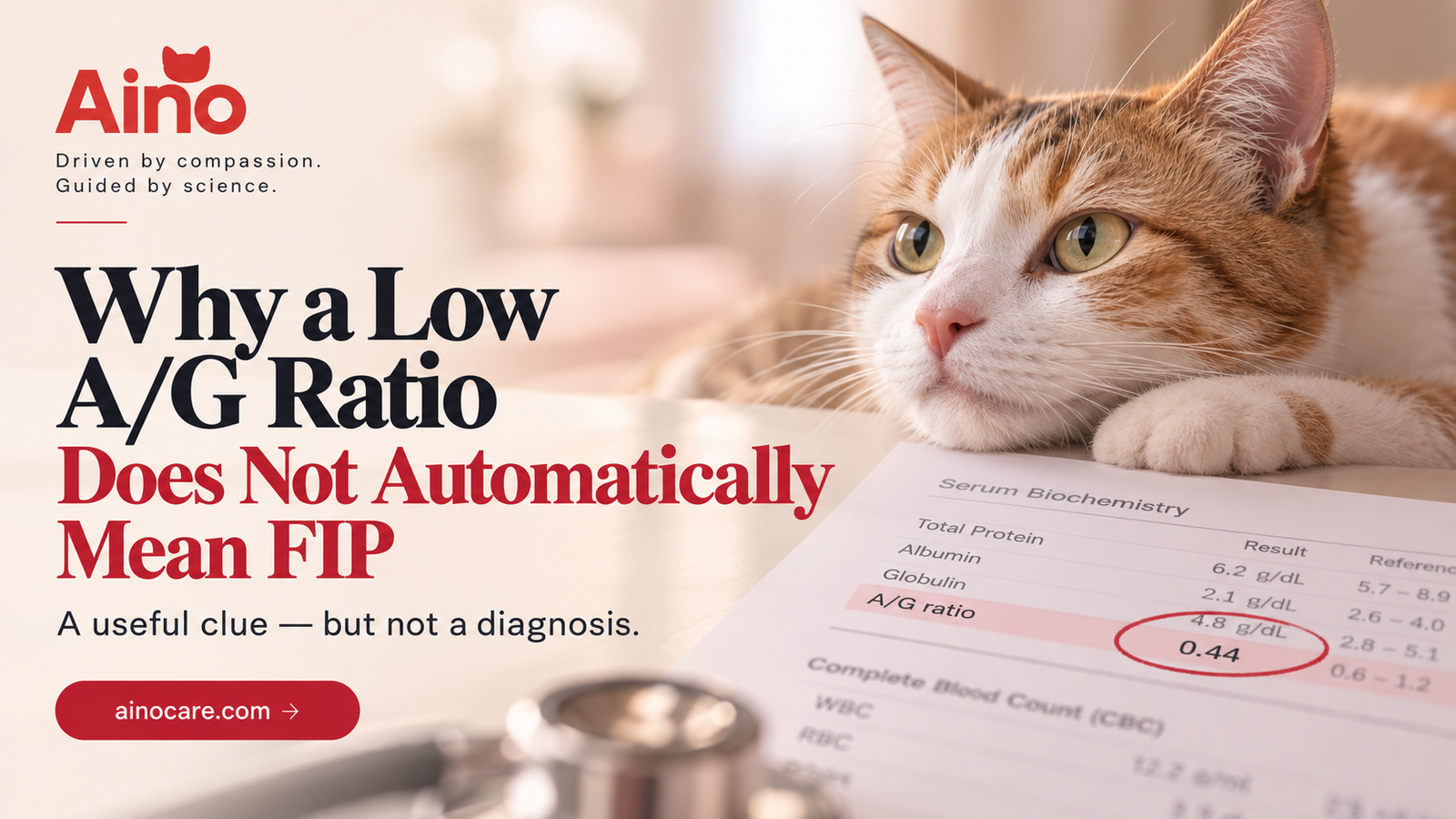
Does an A/G ratio below 0.4 mean your cat has FIP?
Not necessarily.
When discussing A/G ratio and FIP, it is important to understand that a low albumin-to-globulin ratio can be an important clue, but it does not diagnose FIP by itself. A low A/G ratio may increase suspicion when other findings are consistent with FIP, but the result must always be interpreted alongside the cat’s clinical signs, examination findings, bloodwork, imaging, and other diagnostic evidence.
So, what does a low A/G ratio actually tell you, and why is it commonly associated with FIP?
If your cat’s blood test shows an A/G ratio of 0.4, 0.3, or even lower, that result deserves attention. But it should be interpreted as one piece of the diagnostic puzzle, not as the diagnosis itself.
A low A/G ratio CAN support suspicion of FIP. It CANNOT, by itself, diagnose FIP.
This distinction matters because FIP is a complex inflammatory disease, and changes in blood proteins can occur for many different reasons.
Let’s look at what the ratio means, why it can be low, and how it should be interpreted when FIP is suspected.A low albumin-to-globulin (A/G) ratio is an important laboratory finding when veterinarians are evaluating a cat for feline infectious peritonitis (FIP).
What is the A/G ratio in cats?
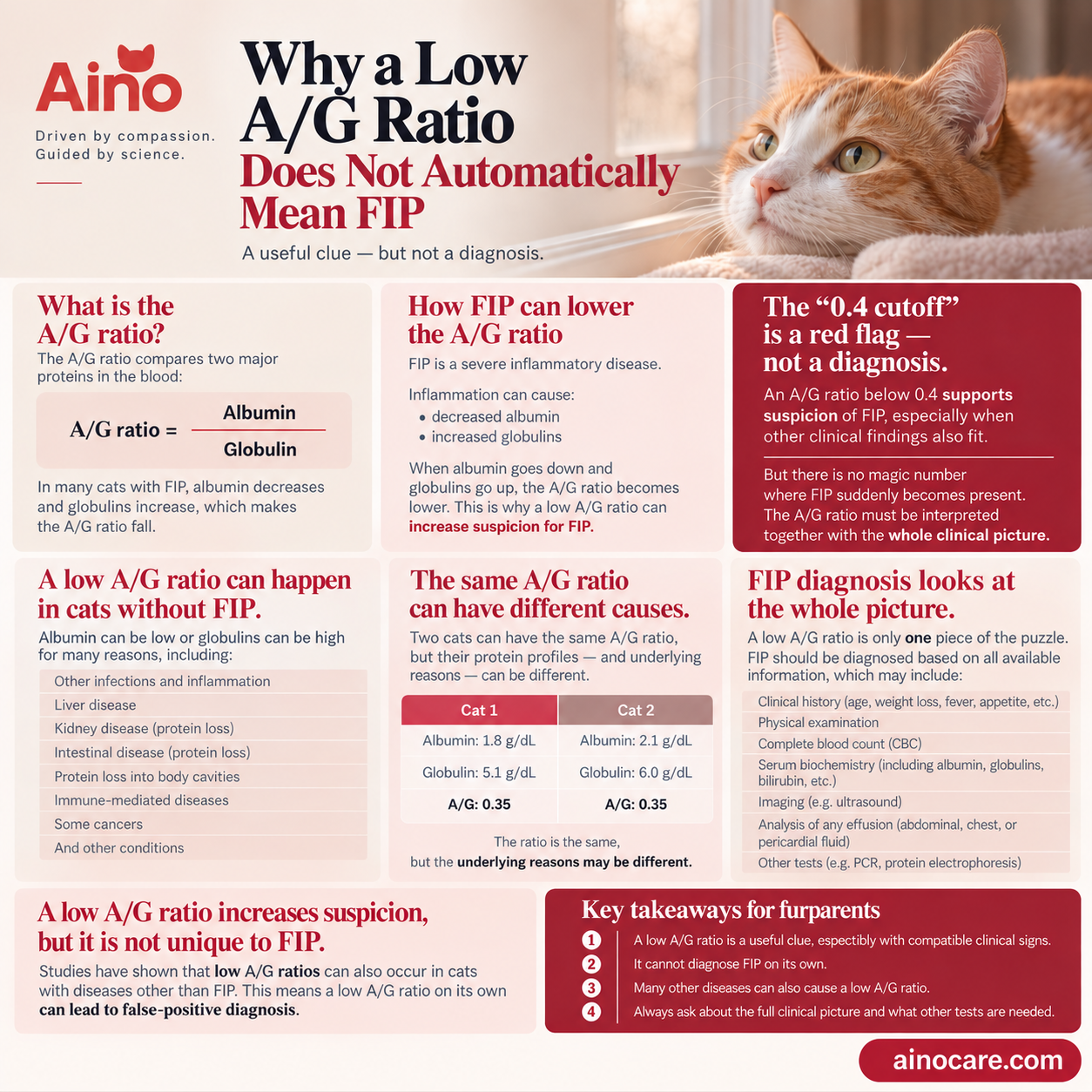
The A/G ratio, or albumin-to-globulin ratio, compares two major groups of proteins in the blood:
A/G ratio = Albumin ÷ Globulin
Albumin and globulins have different functions in the body.
Albumin is the major protein responsible for maintaining oncotic pressure and transporting various substances through the bloodstream. Globulins include a variety of proteins involved in immune function, inflammation, and other biological processes.
Because both albumin and globulin concentrations can change during disease, the A/G ratio can also change.
Why does FIP cause a low A/G ratio?
FIP causes significant inflammation.
In cats with FIP, inflammation may be associated with:
- decreased albumin
- increased globulins
- or both
When albumin decreases while globulins increase, the A/G ratio falls.
This is why a low A/G ratio is commonly associated with FIP.
The current European Advisory Board on Cat Diseases (ABCD) FIP guideline specifically identifies hyperglobulinaemia, a low A/G ratio, hyperbilirubinaemia and increased acute-phase proteins as useful biochemical clues in cats with FIP. However, it also emphasizes that serum biochemical changes in FIP are non-specific.
That last word is important: Non-specific.
Does an A/G ratio below 0.4 automatically mean FIP?
No.
An A/G ratio below 0.4 is a significant finding that can increase suspicion for FIP, particularly when the cat also has clinical signs and other test results that fit.
The current ABCD guideline states that an A/G ratio below 0.4 is associated with FIP, while an A/G ratio above 0.8 makes FIP considerably less likely.
But an A/G ratio of 0.39 does not suddenly become a diagnosis of FIP.
There is no biological switch that flips at:
0.40 → not necessarily FIP
0.39 → definitely FIP
The number is a clinical clue, not a disease-specific marker.
This is why saying: “The A/G is 0.4, therefore the cat has FIP” goes further than the laboratory result can actually tell us.
Why is the “0.4 cutoff” sometimes misunderstood?
Diagnostic numbers are easy to oversimplify.
When furparents hear: “A/G below 0.4 is associated with FIP.”
it can easily become: “A/G below 0.4 means FIP.”
Those statements are not equivalent.
The A/G ratio reflects the relationship between albumin and globulin. It does not identify the underlying cause of those protein changes.
A low A/G ratio can result from:
↓ albumin
or
↑ globulins
or
↓ albumin + ↑ globulins
Multiple diseases and inflammatory processes that can produce these changes.
So the important question is not simply: “What is the A/G ratio?”
It is: “Why is the A/G ratio low in this particular cat?”
Can a low A/G ratio happen without FIP?
Yes.
This is one of the most important things for cat owners to understand: a low A/G ratio is not unique to FIP.
Depending on the individual cat, low albumin and/or increased globulins may occur with other inflammatory, infectious, immune-mediated, hepatic, renal, gastrointestinal, or neoplastic conditions.
Possible explanations can include:
- other infections
- chronic inflammation
- liver disease
- kidney disease associated with protein loss
- gastrointestinal disease associated with protein loss
- protein loss into body cavities
- immune-mediated disease
- some cancers
- other systemic diseases
That does not mean that every cat with a low A/G ratio has one of these conditions.
It means that the A/G ratio cannot tell you which disease is responsible by itself.
The same A/G ratio can have different underlying causes
This is one example why looking only at the ratio can be misleading:
Imagine two cats with an A/G ratio of 0.35.
Cat A
- Albumin: 1.8 g/dL
- Globulin: 5.1 g/dL
- A/G: 0.35
Cat B
- Albumin: 2.1 g/dL
- Globulin: 6.0 g/dL
- A/G: 0.35
The mathematical ratio is identical.
But the actual protein concentrations are different.
And the cats could have very different underlying conditions.
This is why the albumin, globulin and total protein values should be considered alongside the A/G ratio, rather than treating the ratio as an isolated diagnostic result.
What does research say about A/G ratio and FIP?
A/G ratio can be useful, but its diagnostic value depends heavily on the clinical context.
Research helps show why a low ratio should be interpreted as evidence rather than a diagnosis.
A retrospective study of 100 cats with clinical signs compatible with FIP found that the positive predictive value of an A/G ratio below 0.8 was 12.5%, while the positive predictive value below 0.6 was 25% in that referral-hospital population. The authors concluded that using a low A/G ratio to support a diagnosis of FIP in a population where FIP was one of several possible differentials carried a high risk of false-positive diagnoses.
This illustrates an important concept in diagnostic medicine:
A test result does not have the same meaning in every patient.
The probability that a cat actually has FIP before the blood test is interpreted matters: this is called pre-test probability.
What Additional Evidence Can Support FIP?
If the A/G ratio cannot diagnose FIP by itself, what evidence can help?
FIP is a disease that can affect multiple organs and can present in different ways. Therefore, diagnosing FIP involves putting multiple pieces of information together.
1. Effusion
If a cat has an effusion, the fluid itself can provide valuable diagnostic information.
Veterinarians may evaluate:
- appearance
- protein concentration
- cell count
- cytology
- Rivalta’s test
- FCoV RT-PCR
- FCoV antigen detection
- acute-phase proteins such as AGP
The combination of findings can provide much stronger evidence than an isolated serum A/G ratio.
The ABCD guideline notes that proteinaceous effusions with compatible cytological findings and detection of FCoV RNA or antigen can make FIP very likely.
This is an important distinction:
A blood protein ratio can raise suspicion.
Evidence from an affected body compartment can provide much stronger diagnostic evidence.
2. Protein Electrophoresis
Sometimes the question is not simply: “How much globulin does the cat have?”
but:
“What does the globulin pattern look like?”
Serum protein electrophoresis can separate proteins into different fractions and help characterize the pattern of inflammation or gammopathy.
Cats with FIP can show an inflammatory pattern and polyclonal gammopathy.
However, these findings are not exclusive to FIP.
Cornell University College of Veterinary Medicine specifically notes that electrophoretic patterns considered typical of FIP can also occur with other inflammatory conditions.
Again, the same principle applies:
A test can provide evidence without providing certainty.
Can a cat have FIP with a normal A/G ratio?
A/G ratio is helpful, but it should not be treated as an absolute rule-in or rule-out test.
A ratio above 0.8 makes FIP considerably less likely according to current ABCD guidance.
However, diagnostic decisions should still be based on the entire clinical picture.
Likewise:
A low A/G ratio does not automatically mean FIP.
and:
A higher A/G ratio does not automatically mean FIP is impossible.
Laboratory findings have to be interpreted in context.
So, what A/G ratio indicates FIP?
There is no single A/G value that diagnoses FIP.
As a general diagnostic clue:
A/G ratio | General interpretation |
< 0.4 | Stronger suspicion when other findings fit FIP |
0.4–0.8 | Intermediate finding; interpretation depends heavily on clinical context |
> 0.8 | FIP becomes considerably less likely |
These ranges should not be interpreted as standalone diagnostic rules.
The current ABCD guideline specifically identifies <0.4 as a useful clue and >0.8 as making FIP very unlikely, while emphasizing the broader diagnostic picture.
What should furparents ask when their cat has a low A/G ratio?
If you are told that your cat’s A/G ratio is low, don’t ignore the result.
But don’t let the number become the entire diagnosis either.
Ask:
- “What are the actual albumin and globulin values?”
- “Is the low ratio caused by low albumin, high globulins, or both?”
- “What other bloodwork abnormalities are present?”
- “Does my cat’s clinical presentation actually fit FIP?”
- “Is there an effusion, and can the fluid be analysed?”
- “What other diseases could explain these protein changes?”
- “What additional testing would make FIP more or less likely?”
These questions help turn a single laboratory number into a proper diagnostic investigation.
The Bottom Line: Is A/G Ratio Enough to Diagnose FIP?
No.
A low A/G ratio is a useful clue when evaluating a cat for FIP.
An A/G ratio below 0.4 can increase suspicion, especially when the cat also has clinical signs and other findings consistent with FIP.
But:
A/G < 0.4 ≠ automatic FIP diagnosis.
The ratio can be affected by changes in albumin, globulins, or both, and similar protein abnormalities can occur with diseases other than FIP.
Use the A/G ratio to raise suspicion. Use the whole clinical picture to evaluate that suspicion.
A number on a blood test can raise an important question.
It should not be allowed to answer the entire question by itself.
Frequently Asked Questions
1. Is an A/G ratio of 0.4 a sign of FIP?
It can be a sign that increases suspicion for FIP, but it does not diagnose FIP by itself. The cat’s clinical signs, other bloodwork, imaging and additional testing should also be considered.
2. Can a cat have FIP with a normal A/G ratio?
Yes. An A/G ratio is a useful clue, but it should not be treated as an absolute rule-in or rule-out test. A higher ratio can make FIP less likely, but the complete clinical picture still matters.
3. Can a cat have a low A/G ratio without FIP?
Yes. Changes in albumin and globulins can occur with a number of infectious, inflammatory, immune-mediated, hepatic, renal, gastrointestinal and other diseases.
4. Can A/G ratio alone diagnose FIP?
No. Just like how the so-called “FIP Test Kits” alone are not enough to reliably diagnose FIP, A/G ratio is a laboratory clue, not a standalone diagnostic test for FIP.
5. What tests are used to diagnose FIP?
Depending on the cat, veterinarians may use clinical examination, CBC, serum biochemistry, imaging, analysis of effusions, cytology, FCoV RT-PCR or antigen testing, protein electrophoresis and, when appropriate, histopathology. The most useful combination depends on the individual case.
6. Is a normal A/G ratio enough to rule out FIP?
No single blood value should be used in isolation. An A/G ratio above 0.8 makes FIP considerably less likely, but the complete clinical picture still matters.
If your cat is suspected of having FIP
Ask your veterinarian questions. Understanding what each test is looking for, what its results can and cannot tell you, and what other conditions are being considered can make an overwhelming situation easier to navigate.
Most importantly, don’t feel that you need to understand every laboratory abbreviation or diagnostic test overnight.
Your veterinarian’s job is to interpret the findings in the context of your individual cat.
FIP can be a complicated diagnosis. But with a careful, systematic approach, the pieces can begin to come together.
Driven by compassion, guided by science | ainocare.com
This article is intended for educational purposes and should not replace veterinary examination or individualized diagnostic advice. FIP can resemble other diseases, and diagnostic testing should be selected and interpreted by a veterinarian based on the individual cat.